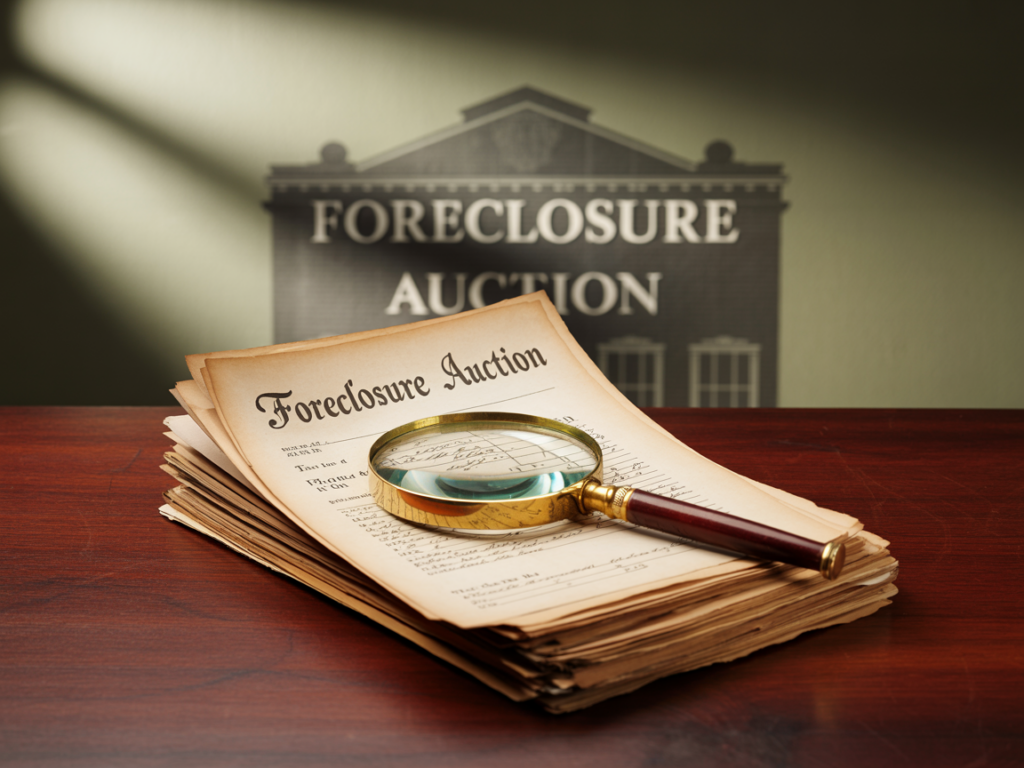
Every seasoned foreclosure investor knows the golden rule: the deal you think you’re getting is only as good as the title behind it. County auctions can resemble treasure hunts for bargain properties, but these bargains can quickly turn into financial traps if you don’t uncover what’s lurking in the chain of title. Mortgages that survive foreclosure, hidden HOA liens, or old judgments can follow the property right into your lap the moment you’re the winning bidder.
The problem is that time is short. Auction calendars don’t wait, and ordering full attorney-prepared title searches on every property you’re considering is both expensive and impractical. That’s where a specialized tool designed for investors comes into play: the Foreclosure Title Search. At EasyTitleSearch.com, we developed this streamlined report to give investors the right level of due diligence for county auctions faster and more affordable than a full title search, but far more reliable than a quick pencil search.
In this article, we’ll explore precisely what a Foreclosure Title Search is, how it compares to other common search types, when it makes sense to use it, and what risks you still need to watch out for. By the end, you’ll understand how to use this tool to bid smarter at foreclosure auctions and avoid the costly surprises that catch unprepared investors.
In this Article:
What Is a Title Search?
At its core, a title search is a deep dive into the public records to answer one key question: who really owns this property, and what claims or debts are attached to it? Every time real estate changes hands, documents are recorded at the county level, including deeds, mortgages, liens, court judgments, and releases. A title searcher pieces together this paper trail to confirm ownership and uncover obligations that may follow the property.
In a traditional retail transaction, such as buying a home with a mortgage, a full title search is typically performed by a title company or attorney. That search supports the issuance of title insurance, which protects both the buyer and the lender from hidden defects. Because there’s a policy in place, the title company has to examine the chain of title in detail, sometimes going back decades, to ensure every prior transfer was valid and every lien is accounted for.
For investors buying at foreclosure auctions, the situation is very different. You’re not getting title insurance, and you’re not closing through a bank. The sale is quick, final, and binding. Once you win the bid and pay, you own the property liens and all within a few days to a few weeks, depending on the state. That’s why investors must do their own title research ahead of time, even if it’s a more streamlined version than what’s required in a financed retail closing.
The Foreclosure Auction Investor’s Dilemma
The challenge for investors is that foreclosure auctions don’t give you the luxury of time or budget. A county might list dozens or even hundreds of properties for an upcoming sale date, and you may only have a few days to decide which ones are worth bidding on. Ordering a full title search on every property could cost thousands and take too long, but skipping due diligence altogether is a recipe for disaster.
This creates a dilemma: how do you get enough information to make confident bidding decisions without over-investing in research? That’s where specialized search products come in. Over the years, investors and search providers have developed a few variations like pencil searches, owner and encumbrance reports, two-owner searches, and nowthe Foreclosure Title Search, that each balance speed, cost, and depth differently.
The goal isn’t to replace a full title search. Instead, it’s to give foreclosure buyers the right level of insight, fast enough and affordable enough to cover multiple properties, so they can bid with confidence and avoid obvious title traps.
Common Types of Title Searches & Reports Explained
Over time, real estate investors have come to rely on a handful of report types when evaluating properties. Each one offers a different balance of speed, depth, and cost, and knowing the difference can save you from using the wrong tool for the wrong job.
A pencil search is the bare minimum. Think of it as a quick scan of open mortgages and judgments tied to the property. It’s fast and inexpensive, but it’s also incomplete. Many investors treat it like a first filter: useful for eliminating obvious problem properties, but never enough to justify bidding on its own.
A step up from that is the Owner & Encumbrance report, or O&E report. This focuses on the current owner and lists any liens or encumbrances that appear in the official records under that ownership. For example, if the current owner has a second mortgage or unpaid property taxes, the O&E report will flag it. The limitation is that it doesn’t look back far enough to catch older liens that might still survive the foreclosure sale. Typical O &E reports will stop at the last deed transfer regardless of the type. For auction investors, that blind spot can be costly.
More thorough is a regular two-owner search. Instead of stopping with the current owner, this type of report pulls the chain of title back two ownerships to look for issues that may have been carried forward. It’s more work and more cost, but it gives a clearer picture than an O&E report alone. Traditional two-owner searches are often used by cautious investors or by professionals preparing for private sales. Again, this might not be enough to uncover encumberancebeyond the last 2-owners when there was a traditional closing with a deed that was warranted.
Then there’s the Foreclosure Title Search, which is the approach we’ve built specifically for auction buyers at EasyTitleSearch.com. It’s a modified two-owner search that goes back until we hit the last deed transfer of value, the point where title insurance was most likely issued at closing. From there, we bring the chain forward to the present. This method lets us piggyback off the insured transaction that has a warranty deed, which significantly reduces the chance of missing prior defects while keeping the process fast and affordable. The result is a report tailored to investors who need reliable data quickly, without paying for a full title search that comes with insurance and attorney review.
Understanding these distinctions matters. A pencil search might be enough to spot a dead-end deal, while a foreclosure title search can give you the confidence to bid at auction without overspending on due diligence. Knowing which tool to use and when will often mean the difference between walking away with a deal and walking into a trap.
What Is a Foreclosure Title Search?
A Foreclosure Title Search is a specialized report built with one purpose in mind: helping investors make smarter, safer bids at county foreclosure auctions. Unlike a retail title search that digs through decades of ownership history and comes with insurance, this version is designed to balance speed, cost, and practicality for buyers who may be researching dozens of properties in a short window.
The concept is simple but powerful. We start by looking for the last deed transfer of value, meaning a sale where the buyer likely purchased title insurance and had a warranty deed. That prior insured closing acts as a clean anchor point in the chain of title. Once that transaction is found, we “piggyback” off it, because the title insurance company would have already examined everything that came before. From that anchor, our team brings the record forward, capturing every deed, mortgage, lien, and judgment that attaches to the property up to the current owner.
In many cases, this process only requires going back two owners. In others, it might take three or more to reach the last insured deed. Either way, the focus remains the same: stop at the last verified insured transfer and then build forward, ensuring nothing that could impact your purchase is overlooked. This is why we describe it as a “modified two-owner search.”
One of the defining traits of a Foreclosure Title Search is that it relies solely on official county records. We’re not pulling data from third-party aggregators or incomplete databases. By using the courthouse records themselves, the report reflects the same filings that will determine your rights and obligations once you own the property.
It’s important to note what this product is, and what it isn’t. A Foreclosure Title Search is not a full title search, and it doesn’t come with insurance or a legal opinion. It’s not designed for retail closings or financed transactions. Instead, it’s a practical due diligence tool for investors: faster than a full title search, more reliable than a simple O&E or pencil search, and priced to make it feasible to run on multiple properties before an auction.
For foreclosure buyers, it hits the sweet spot. You get enough depth to flag risks like second mortgages, tax liens, or judgments that will survive the foreclosure, but you avoid overspending on research for properties you might never even win.
How a Foreclosure Title Search Differs From a Full Title Search
At first glance, a Foreclosure Title Search might sound like a scaled-down version of a full title search. In reality, the two products are built for very different purposes, and understanding the difference can help you decide which one fits your situation.
A full title search is the gold standard in a retail real estate closing. Title companies and attorneys performing these title searches trace the ownership history back decades, sometimes all the way to when the property was first platted. Everydeed, lien, mortgage, release, easement, and judgment is carefully reviewed. That level of detail is required because the end product is a title insurance policy. When you close with insurance, the title company is legally responsible for any omissions. Full searches take more time, cost significantly more, and are designed to support bank financing and long-term ownership.
A Foreclosure Title Search, on the other hand, is tailored for speed and practicality at county auctions. Instead of combing through decades of history, the search works backward until the last insured deed of value is found, then brings the record forward to today. This narrower focus allows investors to piggyback off the work already done at that insured closing, while still catching any liens or encumbrances that attach after it. By cutting out the deeper historical legwork, the report can be completed faster and at a much lower cost.
The trade-off is essential to keep in mind: a Foreclosure Title Search does not come with title insurance or a legal opinion. If a hidden issue is missed, you, as the investor, carry the risk. That’s why it’s not appropriate for financed purchases or retail buyers. But for auction investors, where speed and affordability matter as much as accuracy, it’s a smart compromise.
Think of it this way: a full title search is like commissioning a full set of blueprints before building a house. AForeclosure Title Search is more like having a detailed inspection checklist, enough to make sure the structure is sound before you decide to buy, without paying for the entire architectural history.
Who Should Use a Foreclosure Title Search?
The Foreclosure Title Search was created with one audience in mind: investors preparing to bid at county foreclosure auctions. These buyers don’t have the time or budget to order full title searches on every property, but they also can’t afford to gamble on incomplete information. For them, a targeted report that balances depth, speed, and cost is the perfect middle ground.
If you’re an investor who screens multiple properties every month, the value becomes obvious. Instead of spending hundreds of dollars per report or taking the risk of going in blind, you can order Foreclosure Title Searches on your shortlist of properties and quickly eliminate the ones with liens that would survive the sale. This lets you focus your energy and capital on the deals that have a real chance of delivering equity.
The product is also well-suited to experienced investors who already understand how foreclosure auctions work. If you know the basics of what liens survive foreclosure versus which ones are wiped out, the report gives you the raw data you need to make your decision. It’s not designed to come with legal interpretation; that’s part of why it’s so affordable, but it gives you the official record trail to evaluate risk with confidence.
On the flip side, a Foreclosure Title Search is not for everyone. If you’re buying a property through a traditional sale with bank financing, you’ll need a full title search and insurance. The same applies if you’re an end-user looking to live in the home rather than flip or hold it as an investment. Similarly, suppose you’re dealing with highly complex situations, such as multi-parcel properties, commercial buildings, or long chains of disputed ownership. In that case, you’ll want the safety net of a full attorney-prepared search.
For the typical foreclosure investor, though, the Foreclosure Title Search is a practical fit. It offers just enough detail to steer you clear of hidden traps, while keeping the process affordable and fast enough to keep up with the pace of county auctions.
Benefits of Using EasyTitleSearch.com’s Foreclosure Title Search
When you’re preparing for a foreclosure auction, every hour and every dollar counts. EasyTitleSearch.com’sForeclosure Title Search was built to give investors the confidence they need to bid, without the delays and expense of a full search. The benefits go beyond just saving time and money; they directly affect your ability to spot real opportunities and avoid costly mistakes.
Speed is one of the biggest advantages with turnaround times as quick as the same day. Auctions often come with tight deadlines, and you may only have days to make a decision. Our process is designed for quick turnaround, so you can review the results before bidding day. Instead of waiting a week or more, you’ll have actionable data in time to make a smart move.
Cost is another factor. At county auctions, you might be tracking ten or twenty properties, knowing you’ll only bid on one or two. Ordering a full title search on every property is unrealistic. Our Foreclosure Title Search is priced to make it feasible to order several at once, giving you coverage across your entire watchlist. The lower cost allows you to do more due diligence without breaking your budget.
The investor-first approach also sets our service apart. Everything about the report is tailored to the realities of foreclosure auctions. We don’t pad it with unnecessary details meant for retail closings. Instead, we focus on what matters most to an investor: recorded liens, mortgages, judgments, and ownership history since the last insured deed of value.
Accuracy matters too. Our searches are based entirely on official county records, not third-party databases that can be incomplete or out of date. That means the results reflect the same filings the county clerk will recognize once the property is transferred into your name.
The bottom line is simple: using EasyTitleSearch.com’s Foreclosure Title Search lets you approach the auction block with confidence. You know what claims might survive the sale, you know which properties to avoid, and you’ve spent a fraction of the time and money it would take to gather that intelligence through other methods. It’s the kind of edge every investor needs in a competitive market.
The Limitations and Risks You Need to Know
A Foreclosure Title Search is a powerful tool, but it’s equally important to understand what it does not cover. Recognizing these boundaries helps investors use the report effectively and avoid being blindsided.
The most significant limitation is that a Foreclosure Title Search does not come with title insurance. Unlike a full title search prepared for a traditional closing, there is no policy in place to protect you if something is missed. That means you assume the risk if a defect surfaces later.
Another point to keep in mind is that public records are not perfect. Not every lien or judgment is guaranteed to be recorded, and in some cases, filings may be indexed under the wrong names. While our process is designed to be as accurate as possible, there are rare situations where an encumbrance cannot be found without the exhaustive review that comes with a full title search. For practical purposes, these misses are extremely uncommon, but they are part of the inherent risk of working without title insurance.
It’s also important to remember that some issues simply fall outside the scope of a foreclosure title search. Municipalliens, unpaid utility balances, open code violations, or outstanding permits that might not appear in the official records at the time of the search. Experienced investors typically account for these possibilities by checking with the municipality directly or by adjusting their bids to allow for potential post-auction expenses.
In short, a Foreclosure Title Search gives you the clearest picture possible from the recorded chain of title, but it is not a guarantee of perfection. When used with these limitations in mind, it’s a cost-effective and practical tool for making smarter decisions at the auction block.
Second, there is no legal opinion included. The report provides the facts from the county’s official records, but it does not interpret the law or offer advice on how specific liens or judgments will behave at foreclosure. That’s where your own knowledge, or consultation with a qualified attorney comes in. Experienced investors know how to read the data and decide what’s safe to bid on.
Third, the search is limited to recorded documents. Some obligations, such as municipal code violations, unpaid utility bills, or association fees not yet filed in the public record, may not appear. These “off-record” risks are part of the reality of buying at foreclosure auctions, and investors should be prepared to do additional checks when necessary.
Finally, the Foreclosure Title Search is designed as a decision-making tool, not a closing-ready product. It gives you a reliable snapshot of liens and encumbrances tied to the property, but it’s not intended to replace the comprehensive work required for retail closings or financed purchases.
When used as intended, these limitations aren’t drawbacks; they’re part of the design. By stripping away what you don’t need for auction bidding, the report gives you the essentials quickly and affordably. The key is to treat it as one piece of your due diligence, not the entire picture.
Case Study: How an Investor Used Foreclosure Title Searches to Win Smarter
To see how a Foreclosure Title Search works in practice, let’s walk through a real-world scenario many investors face.
Imagine an investor named Sarah who has her eye on the upcoming county foreclosure auction. The docket lists fifteen properties, and at first glance, several of them look like bargains. But Sarah knows better than to trust surface numbers. She’s heard the stories of investors who thought they scored big, only to discover a six-figure lien waiting for them after the gavel dropped.
Instead of rolling the dice, Sarah orders Foreclosure Title Searches from EasyTitleSearch.com on all fifteen properties. Within a couple of days, she will have clear reports in hand. Five of the properties show major red flags: second mortgages that will survive foreclosure or significant HOA judgments that would transfer directly to the buyer. Sarahimmediately scratches those off her list, saving herself from what could have been a financial disaster.
Out of the remaining ten, three look especially promising. One in particular stands out: a single-family home with minimal liens beyond the foreclosing mortgage. The report confirms that the only surviving obligations would be some county taxes, which Sarah has already factored into her budget. Confident in the numbers, she prepares to bid.
On auction day, Sarah doesn’t waste time chasing every property. She zeroes in on the one that passed her due diligence and secures it at a competitive price. By the time the sale is confirmed, she knows exactly what she’s taking on and what she’s not. In the end, her disciplined approach nets her a property with solid equity and none of the surprises that sink so many inexperienced bidders.
This example highlights the real power of the Foreclosure Title Search. It doesn’t guarantee perfection, but it gives investors the clarity they need to separate good opportunities from dangerous traps. For Sarah, the cost of a handful of reports was nothing compared to the value of avoiding bad deals and winning the right one.
What to Use for Your Next Auction
Buying at foreclosure auctions can be one of the fastest ways to build equity, but it’s also one of the riskiest. Thedifference between walking away with a deal and walking into a disaster often comes down to how much you know about the property’s title before you bid.
A Foreclosure Title Search strikes the balance that investors need. It’s faster and less expensive than a full title search, yet far more reliable than a simple pencil search or O&E report. By anchoring the search to the last insured deed of value and pulling forward from there, it gives you a clear picture of liens and encumbrances that could survive the foreclosure sale. It won’t come with insurance or a legal opinion, but it gives you exactly what you need to make smarter, safer bids at auction.
At EasyTitleSearch.com, we built this product specifically for investors like you, people who want actionable information without wasting time or money. Whether you’re tracking a handful of properties or preparing for a busy auction docket, our Foreclosure Title Search can help you spot red flags early, avoid costly mistakes, and zero in on the deals worth chasing.
If you’re serious about bidding at county auctions, don’t go in blind. Protect your capital and boost your confidence by ordering a Foreclosure Title Search before you raise your paddle.
Order your Foreclosure Title Search today at EasyTitleSearch.com and make your next auction a winning one.